
 Français
 Deutsch
 Español
 Português


Understanding packaging capacity is crucial for manufacturers, retailers, and consumers alike. This comprehensive guide will walk you through the concepts of standard and overflow capacity, as well as the conversion between milliliters and fluid ounces.
A quick overview of the topics covered in this article.
Standard vs. Overflow Capacity
Standard Capacity
Also known as net fill capacity(NFC) represents the normal, commercial volume of a bottle. It’s typically measured in cubic centimeters (cc), milliliters (ml), or ounces (oz). This capacity includes the space for the product and necessary headspace for expansion. When filled to standard capacity, the contents usually reach the bottle’s shoulder area.
Overflow Capacity(OFC)
Refers to the maximum volume a bottle can hold if filled to the very brim. This measurement is crucial for determining the exact amount of product a package can contain, based on a specific gravity of 1.0 or water. OFC is expressed as a range to allow for production control.
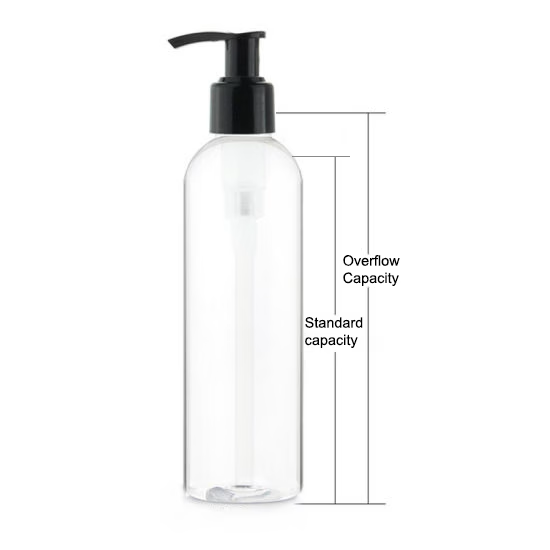
Understanding these differences is vital for several reasons
- Product Fitting: It helps determine how much product will fit into a bottle.
- Overfilling Potential: In some cases, you might be able to fill more than the standard capacity if the overflow capacity allows.
- Quality Control: Overfilling can lead to issues like leaking or bottle breakage, especially considering liquid expansion due to temperature changes.
Understanding Milliliters and Fluid Ounces
Milliliter (mL): A metric unit of volume equal to 1 cubic centimeter or 1/1,000 of a liter. It’s often used in medical dosages and can be abbreviated as mL, ml, or mℓ.
Fluid Ounce (fl oz): A US customary unit of volume equal to 1/16 of a pint or 1/8 of a cup. One fluid ounce is approximately 29.5735 milliliters, though in nutrition labeling, it’s rounded to exactly 30 milliliters.
Converting Milliliters to Fluid Ounces
For those working with both metric and US customary units, converting between milliliters and fluid ounces is often necessary. Here’s a simple formula:
fluid ounces = milliliters × 0.033814
For example, to convert 5 milliliters to fluid ounces:
5 mL × 0.033814 = 0.16907 fl oz
Conclusion
In conclusion, understanding packaging capacity and unit conversions is essential for accurate product filling, labeling, and quality control. Whether you’re a manufacturer ensuring proper fill levels, a retailer managing inventory, or a consumer checking product quantities, this knowledge is invaluable in the world of packaging and product management.
Let's Talk
Packaging
Are you seeking cosmetic packaging solutions that align with both your brand identity and sustainability goals?
If you're currently facing difficulties in finding the ideal packaging solution, look no further. Gidea Packaging provides a plethora of options to meet your specific needs, including the availability of private molds.
Take the first step towards finding the perfect packaging solution by requesting a complimentary consultation with one of our knowledgeable packaging experts.